Therapy: Drugs, Ablation & Devices · Module 9
ProPacemaker Function and Evolution: ICD to Leadless
How pacing works and how device therapy evolved.
Clinical summary notes
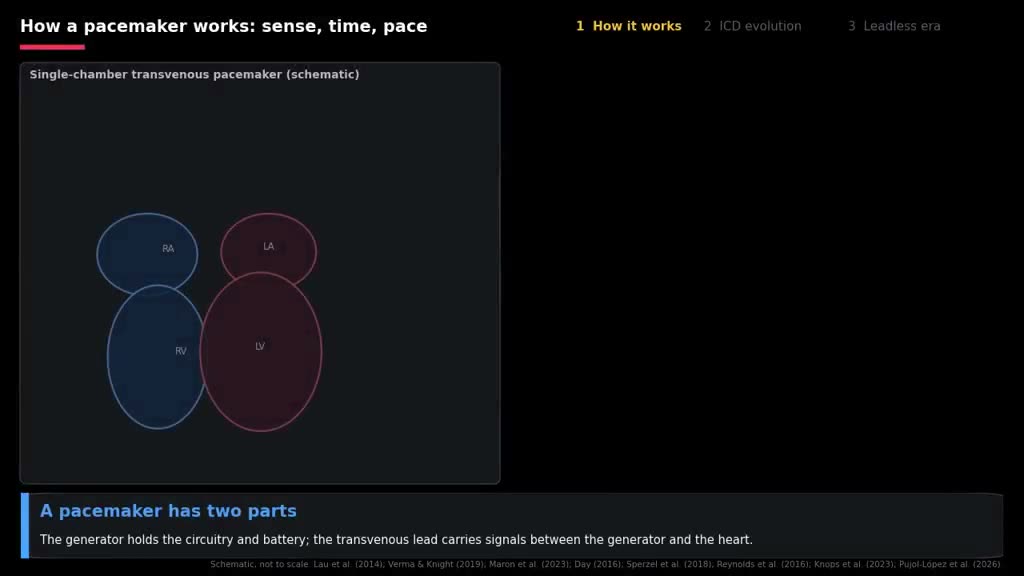
- 1A pacemaker = generator (circuitry + battery) + leads. It senses intrinsic activity and delivers a stimulus when needed; the capture threshold is a key metric. The transvenous lead is the main source of acute and chronic morbidity.
- 2Milestones: first implantable pacemaker 1958 (Elmqvist and Senning); first human ICD implant 1980 (Mirowski), FDA approval 1985; transvenous ICD lead FDA approval 1993; subcutaneous ICD (S-ICD) FDA 2012, with no bradycardia pacing or ATP.
- 3Evolution of pacing: RV pacing (effective but dyssynchronous), CRT (biventricular pacing for selected heart failure), conduction system pacing (His or left bundle area pacing; physiologic activation) and leadless pacemakers.
- 4Leadless pacing: Micra IDE implant success 99.2% (719/725) with major complications HR 0.49 vs transvenous controls; AVEIR DR (dual-chamber): implant success 98.3%, AV synchrony at least 70% in 97.3%.
- 5Limits of leadless: early systems were ventricular-only; retrieval and end-of-service issues; cost. Nanostim was recalled in 2016 for rare battery failure.
- 6EFFORTLESS (S-ICD): 985 patients, 3.1 years; inappropriate shocks 12%, first-shock conversion 89%.
Sources
- Lau, Siu & Tse (2014)
- Verma & Knight (2019)
- Maron et al. (2023)
- Reynolds et al. (2016)
- Knops et al. (2023)
- Pujol-Lopez (2026)
- Sperzel (2018)