Therapy: Drugs, Ablation & Devices · Module 8
ProCatheter Ablation: Radiofrequency, Cryoablation and Pulsed Field
Three energy sources, three lesion mechanisms.
Clinical summary notes
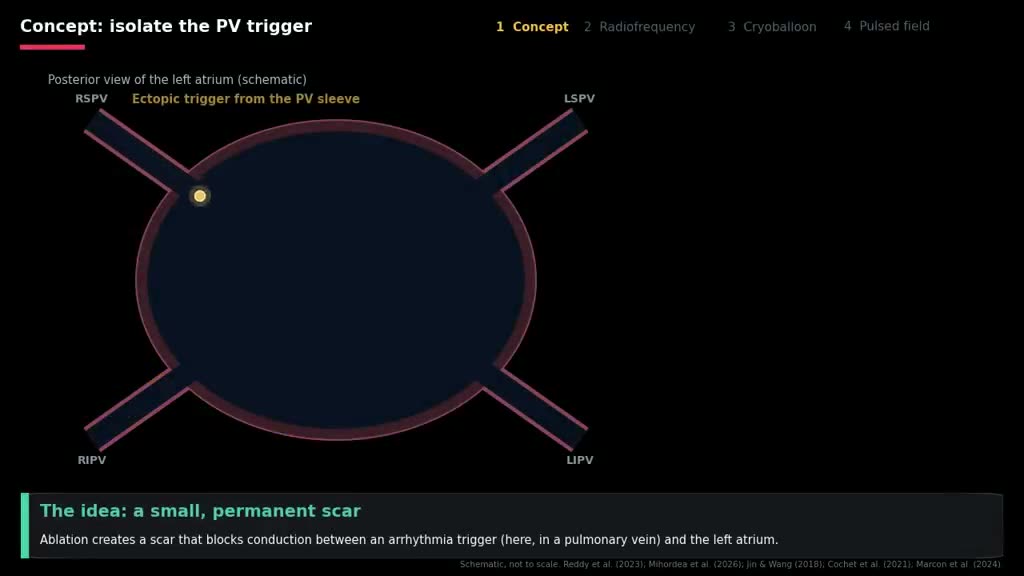
- 1Radiofrequency (RF): resistive heating at the electrode-tissue interface, then conductive heating; tissue necrosis occurs at about 50 degrees C. Point-by-point irrigated catheters with contact-force sensing. Collateral risks: atrioesophageal injury, phrenic nerve palsy, PV stenosis, steam pop and thromboembolism.
- 2Cryoballoon: freezing forms an ice-ball that injures cells; a balloon seals the pulmonary vein ostium for single-shot circumferential isolation. Higher phrenic nerve palsy risk than RF.
- 3Pulsed field ablation (PFA): short high-voltage pulses cause non-thermal irreversible electroporation with relative sparing of the esophagus, nerves and vessels.
- 4ADVENT: 607 patients with paroxysmal AF; 1-year success 73.3% (PFA) vs 71.3% (thermal); primary safety events 2.1% vs 1.5%. The trial showed noninferiority, not superiority.
- 5FIRE AND ICE: cryoballoon was noninferior to RF for pulmonary vein isolation.
- 6Ablation also treats SVT (focal atrial tachycardia and typical flutter are curative targets) and scar-related VT.
Sources
- Mihordea et al. (2026)
- Sulkin & Meyers (2021)
- Sayed & ElMaghawry (2016)
- Cochet et al. (2021)
- Reddy et al. (2023), ADVENT