Therapy: Drugs, Ablation & Devices · Module 7
Free PreviewAntiarrhythmic Drugs: Vaughan Williams Classification
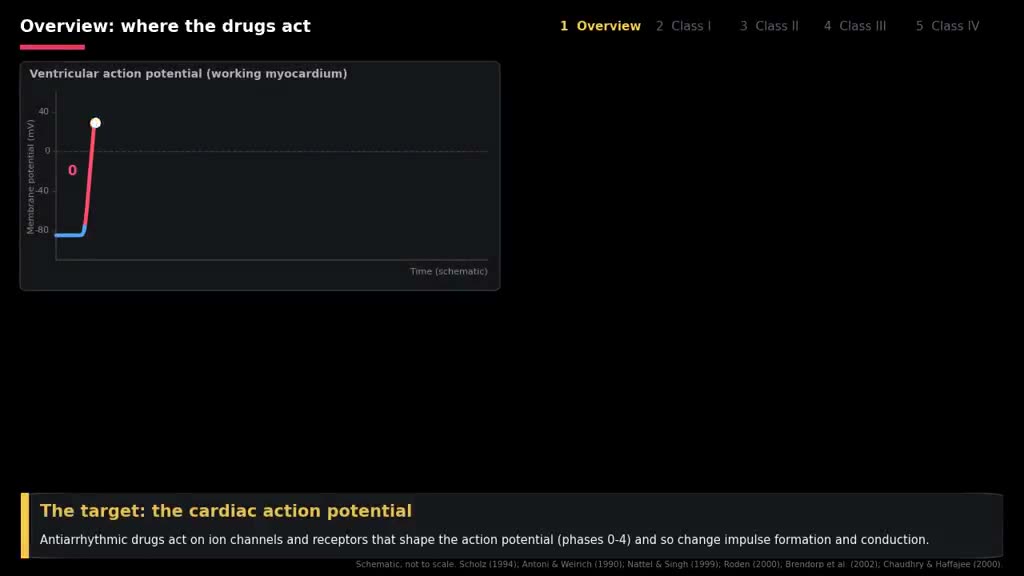
Match drug class to channel target, ECG effect and risk.
Clinical summary notes
- 1Class I blocks fast sodium channels: Vmax falls and conduction slows. Block builds at faster rates (use dependence). Ia: quinidine, procainamide, disopyramide (QRS widens, QT prolongs). Ib: lidocaine, mexiletine (little QRS or QT change). Ic: flecainide, propafenone (markedly wider QRS).
- 2Class II blocks beta receptors: flatter phase 4 slope, lower automaticity, slower AV conduction (PR lengthens). Risks: bradycardia and AV block.
- 3Class III blocks potassium currents (IKr, IKs): longer action potential and refractoriness, QT lengthens. The effect is greatest at slow rates (reverse use dependence), which favors EADs and torsades. Correct electrolytes (K, Mg) and monitor at initiation.
- 4Class IV blocks L-type calcium channels (verapamil, diltiazem): slower AV nodal conduction, PR lengthens; used for SVT and AF rate control; avoid in heart failure.
- 5Limits of the scheme: many drugs act on several targets, digoxin and adenosine fall outside it, and every antiarrhythmic can be proarrhythmic.
- 6CAST (1991) showed higher mortality with class Ic drugs (encainide, flecainide) after myocardial infarction.
Sources
- Scholz (1994)
- Antoni & Weirich (1990)
- Weirich & Wenzel (2000)
- Brendorp et al. (2002)
- Nattel & Singh (1999)
- Roden (2000)
- Chaudhry & Haffajee (2000)
- Campbell & Williams (2001)
- Shantsila et al. (2007)
- CAST