Arrhythmia Mechanisms · Module 3
Free PreviewMechanisms of Tachyarrhythmia
Automaticity, triggered activity (EAD and DAD) and reentry.
Clinical summary notes
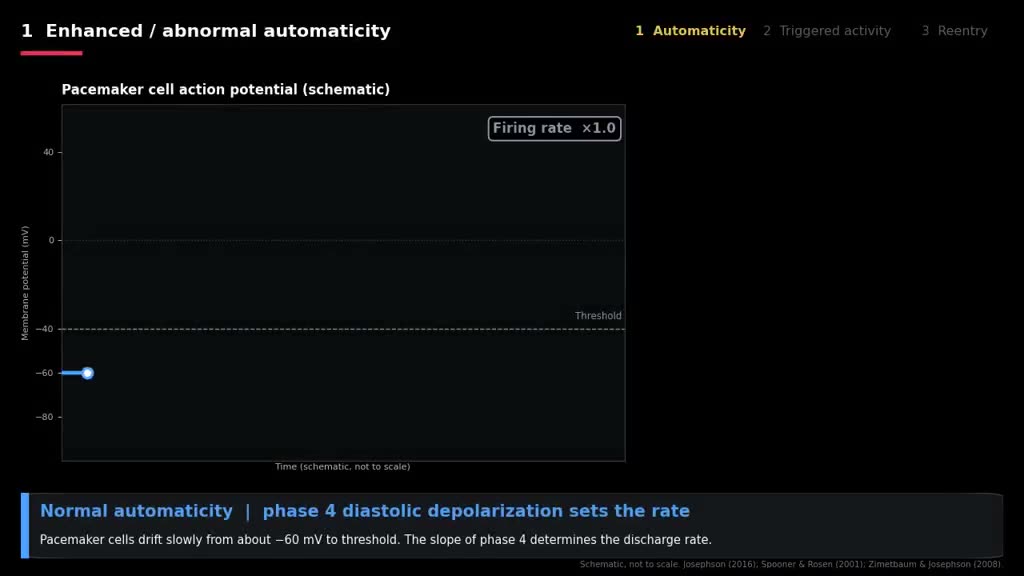
- 1Automaticity: a steeper phase 4 slope makes a focus fire faster than the sinus node. Think ischemia, a catecholamine surge and digitalis toxicity. Partly depolarized myocytes can also become automatic (abnormal automaticity).
- 2Early afterdepolarizations (EADs) arise when repolarization is prolonged and the L-type calcium current reactivates. Repeated triggered beats give torsades de pointes, a twisting polymorphic VT that is often pause-dependent.
- 3Reduced repolarization reserve (reduced IKr or IKs, bradycardia, hypokalemia, some drugs) favors EADs.
- 4Delayed afterdepolarizations (DADs) occur in phase 4, after repolarization is complete. Calcium released from the sarcoplasmic reticulum is extruded by the sodium-calcium exchanger (3 Na+ in : 1 Ca2+ out), creating a net inward current. Think digitalis toxicity, ischemia-reperfusion and heart failure.
- 5Reentry needs two pathways joined at both ends, unidirectional block and slow conduction. It is the dominant clinical mechanism: AVNRT, AVRT, atrial flutter and scar-related VT are examples.
Sources
- Josephson (2016)
- Spooner & Rosen (2001)
- Zimetbaum & Josephson (2008)
- Lecture slide 5